Stratnel has been featured in a podcast by Foundry.org — a detailed conversation available on YouTube. Click the video below to watch it.
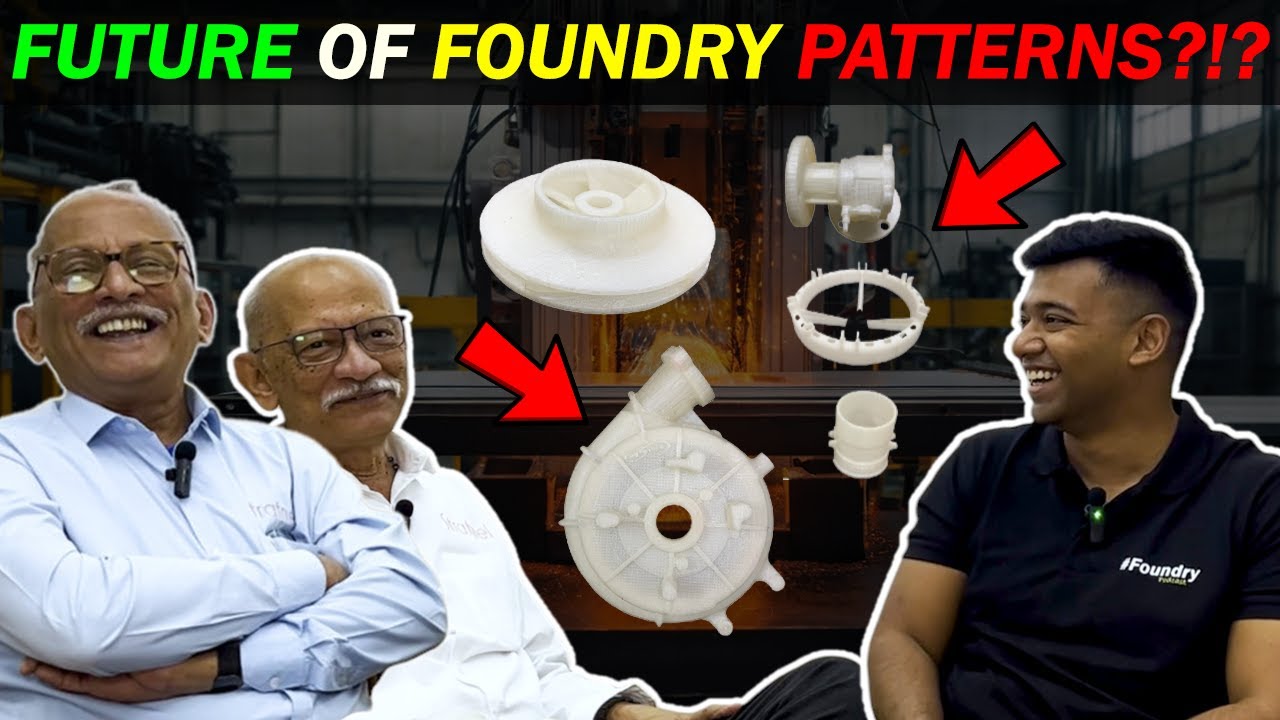
Foundry.org podcast — "Here's How Far 3D Printed Patterns Have Come" · Hosted by Ian Nazareth
The Stratnel cofounders tell their story here — how they started Stratnel, how they discovered that 3D printed patterns could help their investment casting customers, and how they uncovered 8 distinct use cases for 3D printed patterns in investment casting.
The Traditional Problem
For most Indian foundries, the investment casting process begins weeks before the first metal is poured — with the pattern. Traditionally, wax patterns are made using aluminium dies, and those dies take anywhere from six to ten weeks to machine. It is a long wait, and for customers who need cast parts to validate a design or bridge a production gap, it is often a wait they cannot afford.
Over the past eight years, Stratnel has supplied thousands of 3D printed wax-replacement patterns to foundry customers across India. The results have been consistent: lead times that used to stretch to eight weeks are now routinely delivered within a week of receiving an order — and foundries can start shelling immediately.
The economics of the conventional pattern-making route create a real barrier for small batches and design iterations:
- Aluminium tooling costs anywhere between ₹50,000 to ₹5,00,000 depending on part complexity
- Tool lead time: 6 to 10 weeks from drawing to first pattern — including tool making, debugging, modifications and additional machining where required
- Any major design change means a new tool — or expensive rework
- Minimum order quantities driven by the need to amortise tooling cost
For a foundry customer who wants 20 castings to test a new impeller design, or a defence contractor who needs 50 brackets before a production decision is made, this model is prohibitively slow and expensive.
The 3D Printed Pattern Route
Stratnel produces investment casting patterns using FDM printing with a proprietary polymer filament that behaves like wax in the shell-building and burnout stages of the casting process. The patterns are dimensionally accurate to ±0.5% of nominal or ±0.3 mm, whichever is larger — and require no tooling of any kind.
Our average lead time for investment casting patterns is typically measured in days. The process from order to dispatched patterns typically runs as follows:
- Day 1: Order confirmed, drawing review, DFM check, shrinkage and machining allowances check, print file preparation
- Day 1–4: Printing, post-cure, dimensional inspection
- Day 5: Quality sign-off, inspection reports, packing, invoicing, dispatch
- Day 6–8: Foundry receives the patterns — shelling can begin immediately
Critically, if a customer makes a design change after reviewing the first castings, we can have revised patterns ready in days — not months. There is no tooling to modify, no cost penalty, no delay waiting for a toolmaker's schedule and expensive machining schedule.
Where This Approach Works Best
3D printed patterns are not a replacement for hard tooling in every situation. Once volumes exceed 300 to 400 pieces per year and the design is frozen, the economics of aluminium tooling become attractive again. But for the following scenarios, the printed pattern route consistently outperforms the conventional approach:
- Design validation and pre-production samples
- Bridge production while tooling is being made
- Low-volume production runs (under 500 pieces per year)
- Complex geometries where tooling costs are disproportionately high
- Spares for legacy machines
- Sampling for strategic RFQs
- Pattern validation before the die is production ready — foundries don't need to wait for a die to validate their process. Order a few 3D printed patterns from Stratnel, start shipping early, and prepone your revenue cycle
- Defence and aerospace projects with long qualification windows and low initial volumes
If you are a foundry or an OEM working with a foundry and facing a tooling lead-time constraint, we are happy to review your drawing and give you an honest assessment of whether the printed pattern route makes sense for your application.
Have a question or a perspective to add? Write to us below — we read every message, and may feature selected responses in a future post.